

Cardiomyopathy Syndrome (CMS)

What is Cardiomyopathy Syndrome?

CMS is a severe heart disease of Atlantic salmon caused by the Piscine myocarditis virus (PMCV). The fish is usually affected during late production stages, mainly in the second year after transferring to sea. In recent years, CMS has also been reported in younger fish.

The economic losses caused by a CMS outbreak can be significant. Over the past years, the frequency of CMS outbreaks has been high throughout Norway, Scotland and the Faroe Islands. In Norway, CMS is ranked the second worst viral disease challenge, behind HSMI (Moldal et al. 2026). CMS remains a major challenge because there is no commercial vaccine available and exposure to the virus is difficult to prevent.
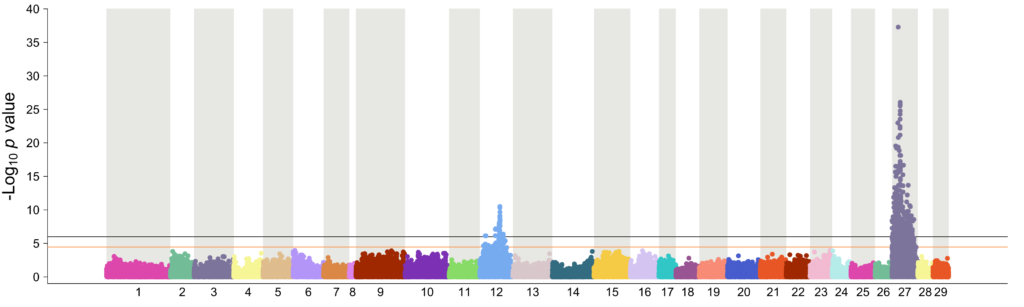
Figure showing the genome-wide association of CMS resistance in our populations. The figure shows the association of thousands of genetic markers tested against the CMS resistance. Each chromosome is designated with a different color. The information from significant QTL (on chromosomes 12 and 27), have been implemented in our breeding program. This has resulted in breeding for fish with high resistance against this disease.
manPlot-1
Figure 1: Manhattan plots. Showing the genome-wide association of CMS resistance in our populations. The figure shows the association of thousands of genetic markers tested against the CMS resistance. Each chromosome is designated with a different color. The information from significant QTL (on chromosomes 12 and 27), have been implemented in our breeding program. This has resulted in breeding for fish with high resistance against this disease.

Recent studies

A new study from Benchmark Genetics, published in 2026, provides compelling evidence that genomic selection (GS) can dramatically improve CMS resistance – documented both in challenge tests and under real commercial field conditions. This study is the first to document the clear effect of genomic selection across generations in both reducing viral load and increasing the probability of survival during CMS outbreaks in commercial environments.


The study confirmed that resistance to PMCV is highly heritable, meaning selective breeding can deliver lasting and cumulative improvements in fish health, welfare, and farm performance across generations.


The research demonstrates that targeted genomic selection yields rapid and substantial improvements:

  • Offspring of parents selected to be resistant to CMS exhibited markedly reduced viral loads following experimental infection.
  • During a natural CMS outbreak, survival in highly selected families was 13.7‑percentage‑points higher than mid-ranked families.

The study confirms that PMCV resistance has a strong genetic component:

  • Heritability of resistance 0.59
  • Heritability of field survival: 0.30
  • Genetic correlation between challenge‑test viral load and real‑world survival: 0.54

The CMS trait

Benchmark Genetics offers CMS robust fish using GS. Selection for resistance to CMS was initiated by QTL/Marker assisted selection in 2018 after a significant QTL affecting the severity of the infection and the damage to the heart was detected in our populations (Hillestad and Moghadam, 2019, Hillestad et al., 2020) .

Refinement in genotyping technologies and further data from challenge testing quickly revealed that this single QTL does not capture all the genetic variation for resistance to this disease. Benchmark Genetics has therefore transitioned from QTL to GS for CMS resistance since 2020, enabling inclusion of both the major QTL and remaining genetic variation for robustness to CMS.

Our recent study confirms that the application of GS is the correct approach to producing a CMS-robust fish and leads to lower level of virus in challenge test. The identification of multiple shared significant QTL and a strong genetic correlation between challenge test and field survival further validates the selection approach that has been implemented over several generations of selection in Benchmark Genetics populations.

Read the full scientific paper: “From Challenge Tests to Field Survival: Cross‑Generational Genomic Selection Improves Cardiomyopathy Syndrome Resistance in Atlantic Salmon (Salmosalar)” (Moghadam et al., 2026)

keyboard_arrow_up
Benchmark Genetics
Privacy Overview

This website uses cookies so that we can provide you with the best user experience possible. Cookie information is stored in your browser and performs functions such as recognising you when you return to our website and helping our team to understand which sections of the website you find most interesting and useful.