


By Dr. Maria Nayfa, Business Development Manager of Benchmark Genetics Services, Published in International Aquafeed (September 2025).
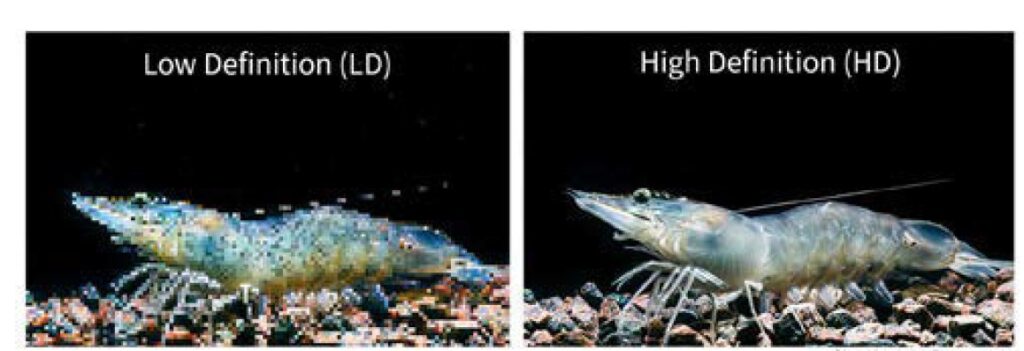
When you look at a photograph, the level of detail you see depends on its resolution. For example, a low-resolution image of a fish might let you recognise the species, but it won’t reveal the fine patterns in its scales. Increase the pixel count, and suddenly the picture and details sharpen.
In aquaculture genetics, Single Nucleotide Polymorphism (SNP, pronounced ‘snip’) panels work much the same way. The density, or the number of markers, of a panel is like the number of pixels in an image; the higher the density, the clearer and more detailed your genetic profile becomes. Just as a photographer chooses the right resolution for the job, breeding programs need to select the SNP density that best fits their needs.
What is a SNP?
A SNP is the simplest and one of the most common types of genetic variation in DNA. It occurs when a single base – adenine (A), cytosine (C), guanine (G), or thymine (T) – is replaced by another. Think of it as swapping one letter in a word; small on its own, but across the genome these changes create genetic diversity within a population. These are the foundation of genetic improvement, and all farmed fish, mollusks, and crustaceans carry millions of them.
For instance, one fish might have a particular allele, say an adenine (A) base, at a specific position in its DNA, while another has a guanine (G) in the same spot. Analysed across many thousands of locations, these patterns reveal valuable information about ancestry, relatedness, and potential performance traits.
Because these SNP alleles are inherited predictably, they’re ideal for identifying superior broodstock, managing inbreeding, and making breeding decisions based on consistent, reproducible data. Like pixels in a photo, their power lies in the number we can genotype rapidly using cost-effective, high-throughput methods – producing detailed genetic ‘pictures’ that tell us about population structure, diversity, and family assignment.
What is a SNP panel?
A SNP panel is a tool used to pull large amounts of specific genetic data from a DNA sample of an individual animal. Each panel contains a fixed set of markers, typically chosen for their even distribution across the genome and high informativeness. Even spacing means that even if a SNP isn’t directly responsible for a trait, it may sit close enough to causal genes to be inherited with it, still capturing the genetic signal.
SNP panels allow for a very accurate estimation of the true relationship between any two individual animals, and this is critical information for accurate and effective selective breeding. As the same set of SNPs is measured every time, SNP panels allow for accurate, repeatable comparisons between individuals and across generations – a crucial feature for long-term selective breeding programs.
Varying SNP panel densities
- Low-density (LD) SNP panels (<2000 markers) are like basic images – enough to capture the outlines and main features without extra detail. They’re perfect for essential day-to-day key tasks like confirming parentage, simple population structure analyses, or conducting routine genetic audits. These panels provide a reliable genetic baseline, and they’re particularly useful for programs that need fast, cost-effective screening across large numbers of individuals.
- Medium-density (MD) SNP panels (2000–20,000 markers) resemble high-quality photos that sharpen the picture without the huge file size of HD images. This density level uncovers subtle but important genetic differences, making it ideal for more in-depth parentage, population structure analyses, routine genetic audits, and most cases of genomic selection. Whether you’re breeding for growth, feed efficiency, disease resistance, or other production traits, MD panels strengthen breeding value estimates and accuracy. Across generations, they consistently boost selection accuracy and genetic gain while preserving diversity, making them the reliable workhorse of modern breeding programs.
- High-density (HD) SNP panels (≥20,000 markers) offer an HD view – capturing the highest level of detail available in commercial genotyping. Their additional marker coverage makes them particularly valuable for applications such as genome-wide association studies (GWAS) to identify genes linked to traits, and in some cases, for enhancing genomic selection when very fine-scale resolution is needed. Additionally, HD panels can perform all the same tasks as medium- and low-density panels.
SNP Panels vs Genotyping-by-Sequencing
Genotyping-by-Sequencing (GBS) is a method that identifies genetic variation by sequencing fragments of an organism’s DNA and detecting the SNPs present in those fragments. Because the fragments are typically generated randomly each time, the exact set of SNPs detected can change from run to run. This makes GBS flexible for discovering new markers, but it also means that results can be inconsistent when you need to compare across different batches or generations.
In contrast, SNP panels always capture the same fixed set of markers, making results directly comparable generation after generation.
Choosing Genetic Tools
At Benchmark Genetics, the Business Development team works with producers to match the resolution of their genetic tools to their breeding goals. For some, that means starting with a low-density panel to clarify broodstock records and manage inbreeding. For others, it involves implementing medium or high-density panels to strengthen genomic selection, increase selection accuracy, deliver faster genetic gain and ultimately improve stock performance on the farm.
Can producers afford SNP panels?
Yes – and often for much less than expected. The company frequently combines several species into a single multi-species panel, sharing development costs and lowering the price per sample. For established species such as salmon and shrimp, high testing volumes enable the company to secure competitive pricing, which is extended across all arrays. The result is market-leading pricing for cutting-edge genomic tools.
Off-the-shelf Panels
For many breeding programs, off-the-shelf SNP panels are an excellent starting point, and usually all you need to achieve meaningful results. These panels are developed with markers distributed evenly across the genome, which means they provide broad, balanced coverage. This built-in coverage makes off-the-shelf panels a cost-effective, low-barrier option for most producers.
They allow you to start collecting consistent, comparable data right away
In many cases, SNP panels deliver the resolution needed to identify and select high-performing broodstock. As you learn more about your population’s genetics, you can move to a customised panel if needed, but the best first step is to put a high-quality, well-distributed panel to work.
Success with SNP Panels
In whiteleg shrimp farming, Enterocytozoon hepatopenaei (EHP) – a parasite that attacks the digestive organ and White Feces Syndrome (WFS) – a condition marked by floating white fecal strings, poor feed intake, and stunted growth — are a costly double blow. Together, they can devastate survival and performance in ponds across Asia and Latin America.
Benchmark Genetics used their 43K HD SNP panel to change the game. Over 1400 shrimp from 47 families in the Colombia breeding program were genotyped, allowing the team to precisely track which genetic profiles were linked to better survival under EHP + WFS co-infection. The results were clear: resistance can be improved over generations and, importantly, is not linked to slower growth.
This genomic insight guided the selection of broodstock, and the benefits carried forward. In the very next generation, farm trials confirmed the gains – the new lines showed strong survival and consistent growth, even in ponds with confirmed EHP and WFS pathogen loads.
By using SNP panels, Benchmark Genetics can capture thousands of genetic markers evenly spread across the genome – ensuring the same high-resolution ‘genetic picture’ is taken every time. That consistency is what makes it possible to track disease resistance traits across generations and turn complex, hard-to-manage problems into measurable breeding gains.
Conclusion
Clarity and consistency are the foundation of effective breeding. By capturing the same set of SNPs every time, panels allow you to track genetic progress with precision and confidence. With the right density, your breeding program’s genetic ‘image’ becomes sharp and reliable, not a blurry guess. In the end, choosing the correct resolution isn’t just a technical decision – it’s a strategic one that shapes the future performance, resilience, and sustainability of your stock.
At Benchmark Genetics, we go beyond supplying genotyping panels. We offer a complete suite of genetics services: including technical reviews, broodstock assessments, breeding program design, and operational support. Whether you need help setting up a new selective breeding program or optimising an existing one, our team works with you to ensure these genomic tools are applied effectively, delivering measurable results.